
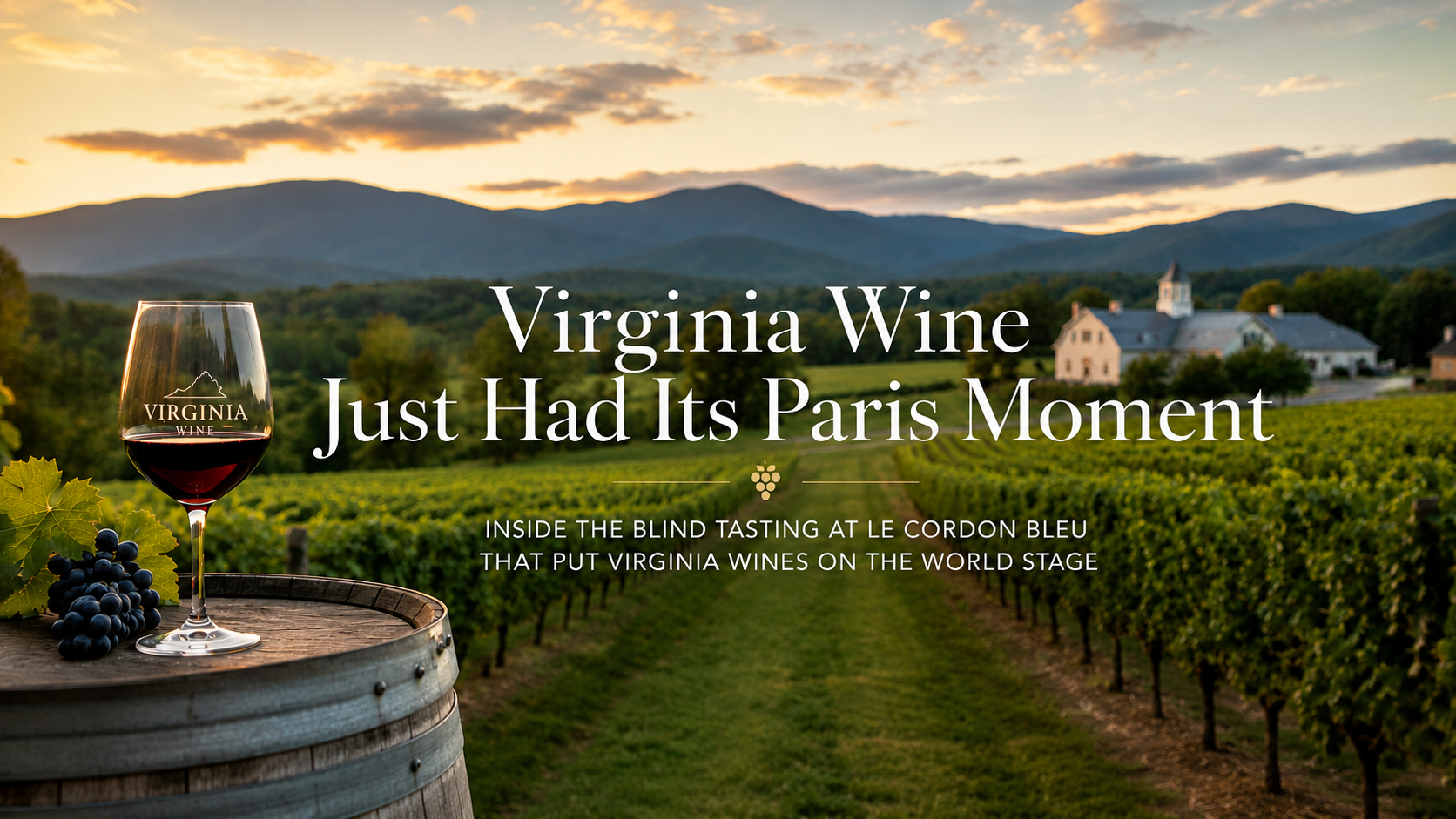
Virginia Wine Just Had Its Paris Moment
On July 1, 2026, Virginia wines were tasted blind against French wines at Le Cordon Bleu Paris in an event called “Old World, New Roots.” The tasting does not mean Virginia suddenly replaced France. It means something more interesting: Virginia wine walked into one of the most symbolic rooms in wine and did not look small.
There are wine moments that feel bigger than the glass. They carry a little electricity. You hear about them and immediately understand that something shifted, even if the shift is quiet at first.
This was one of those moments.
Fifty years after the Judgment of Paris helped put California wine on the world stage, Virginia wines were poured blind against French wines at Le Cordon Bleu Paris. The event, called “Old World, New Roots,” featured four flights: Chardonnay, Petit Manseng, Cabernet Franc, and Merlot-based red blends.
That lineup alone says a lot. Virginia did not show up with novelty wines or a “please be nice to us” energy. It showed up with grapes that actually tell the story of the region.
And according to early reporting from Richard Leahy, Virginia wines posted the highest scores across the tasting categories. Public follow-up coverage has already confirmed one very important result in detail: Valley Road Vineyard’s 2023 Cabernet Franc Estate Reserve placed first in the Cabernet Franc flight, ahead of French wines from St-Émilion and Bourgueil.
That is not a small sentence.
It is also not a sentence we need to abuse.
What happened at the Virginia wine Paris tasting?
At the Virginia wine Paris tasting, twelve Virginia wines were tasted blind against twelve French wines at Le Cordon Bleu Paris. The event was designed to celebrate how far Virginia wine has come over the last fifty years, while placing it in direct conversation with France.
Each flight included three Virginia wines and three French wines. The categories were Chardonnay, Petit Manseng, Cabernet Franc, and Merlot-based red blends. Those are not random choices. They are a smart map of where Virginia is starting to build real identity.
Chardonnay shows whether a region can handle classic white wine without hiding behind perfume or sweetness. Petit Manseng shows Virginia’s willingness to embrace a grape that is still unfamiliar to many casual drinkers but makes serious sense in the state. Cabernet Franc shows the state’s red wine potential with freshness, spice, and structure. Merlot-based red blends connect Virginia to Bordeaux without forcing it to pretend it is Bordeaux.
That is the important part. Virginia is not France. Virginia is not California. Virginia is Virginia. Finally, people seem ready to taste that without smirking.
Is this Virginia’s Judgment of Paris?
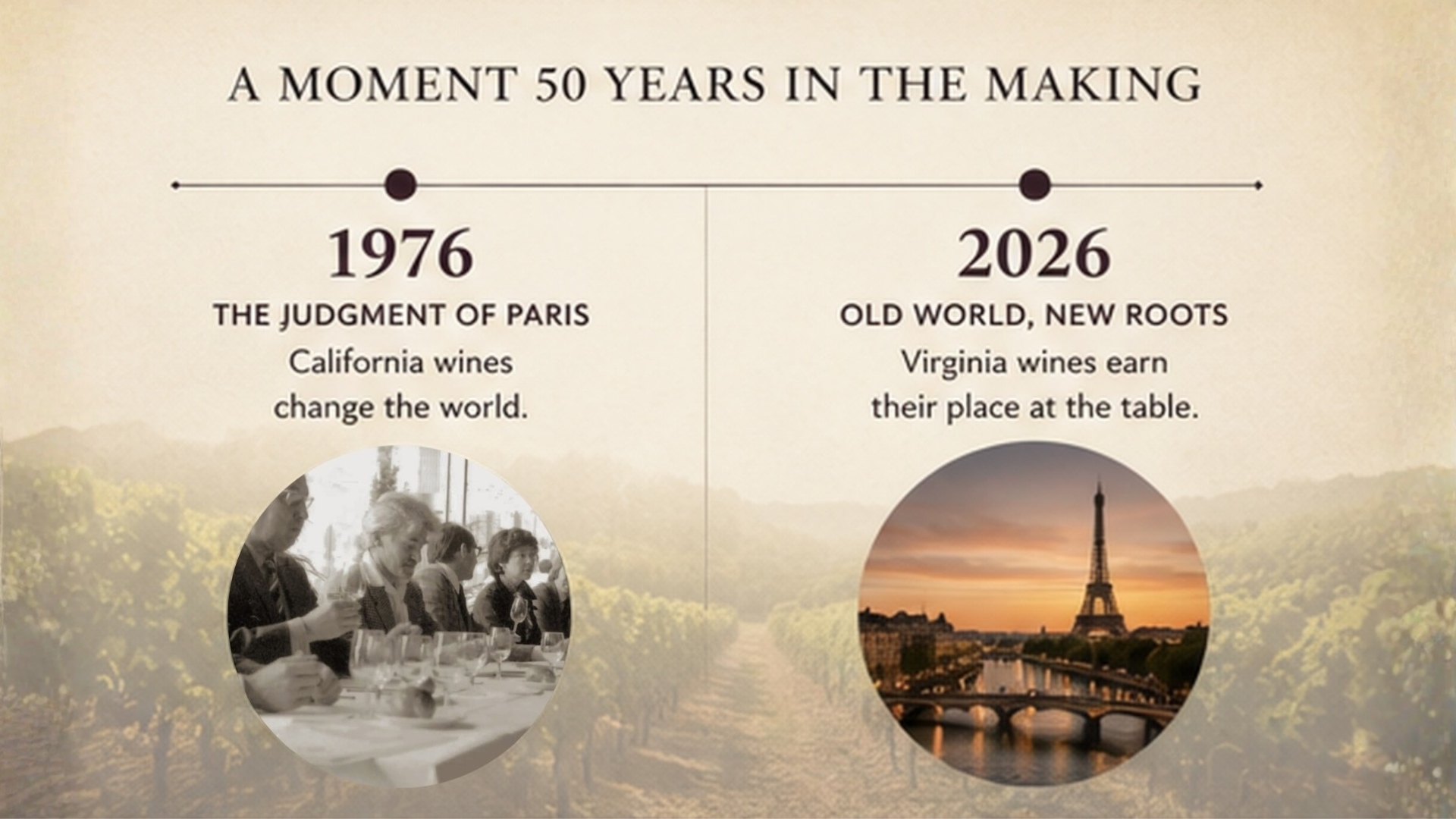
Yes, emotionally. No, mathematically. And that difference matters.
The original Judgment of Paris took place on May 24, 1976. In that blind tasting, California wines were poured beside top French wines. When the results came in, Chateau Montelena Chardonnay and Stag’s Leap Wine Cellars Cabernet Sauvignon placed first in their categories. The wine world blinked hard. A new American wine reality had arrived.
The Virginia tasting in 2026 does not carry the same scale or historical shock. We should not pretend it does. A small blind tasting is not a universal declaration that one region is better than another.
But wine is not only data. Wine is perception, and perception has weight. A blind tasting in Paris, with Virginia wines standing confidently beside French wines, changes the story people are allowed to tell.
Before a tasting like this, some people hear “Virginia wine” and think local curiosity. After a tasting like this, the better question becomes: Which Virginia wines should I be paying attention to?
That is the door opening.
Why does Virginia wine winning in Paris matter?
Virginia wine winning attention in Paris matters because wine reputation is built from layers: quality, timing, authority, story, and repetition. This moment has all of them working together.
First, the tasting was blind. That matters because labels carry baggage. French wine has centuries of prestige stitched into the bottle before the cork is even pulled. Virginia wine still has to explain itself in many rooms. Blind tasting removes some of that theater. Not all of it, because tasters are still human, but enough to make the glass speak louder than the label.
Second, the setting was Paris. Not a hotel ballroom in a suburban trade show. Paris. Le Cordon Bleu. The psychological weight of that room is real.
Third, the timing is almost too good. The 50th anniversary of the Judgment of Paris. The 250th anniversary of the United States. Virginia’s long, complicated wine history stretching back to colonial ambition, Jeffersonian obsession, repeated failure, and stubborn modern rebirth.
That is how the Lollapalooza effect works in marketing: authority, social proof, contrast, timing, scarcity, and story all pulling in the same direction.
But underneath all of that, the wine still had to be good.
Why Cabernet Franc may be Virginia’s strongest red wine argument
Cabernet Franc has always had a little shadow energy. In Bordeaux, it often plays a blending role. In the Loire Valley, it gets more room to speak, especially in places like Chinon and Bourgueil. But in Virginia, Cabernet Franc has become one of the grapes that makes the most sense.
It can ripen earlier than Cabernet Sauvignon. It can offer red fruit, dried herbs, graphite, pepper, violet, and sometimes that savory edge that makes a wine feel less obvious. At its best, Virginia Cabernet Franc does not need to shout. It has posture.
That is why the Valley Road result matters. The same 2023 Cabernet Franc Reserve had already won the 2026 Virginia Governor’s Cup, a competition with more than 670 entries and 224 gold medals awarded across 113 wineries and cideries. Then it went to Paris and topped its Cabernet Franc flight.
One award can be a nice night. Two different moments, in different contexts, start to look like a pattern.
This is where Virginia should be careful, though. The goal is not to make Cabernet Franc taste like Bordeaux or Bourgueil. The goal is to let it taste like a Virginia hillside after a hard growing season, with just enough ripeness, just enough nerve, and just enough honesty.
 Why Petit Manseng might be Virginia’s secret white wine weapon
Petit Manseng is not exactly a beginner-friendly name. It sounds like something you misread on a restaurant list while pretending everything is fine.
But the grape itself? That is where things get interesting.
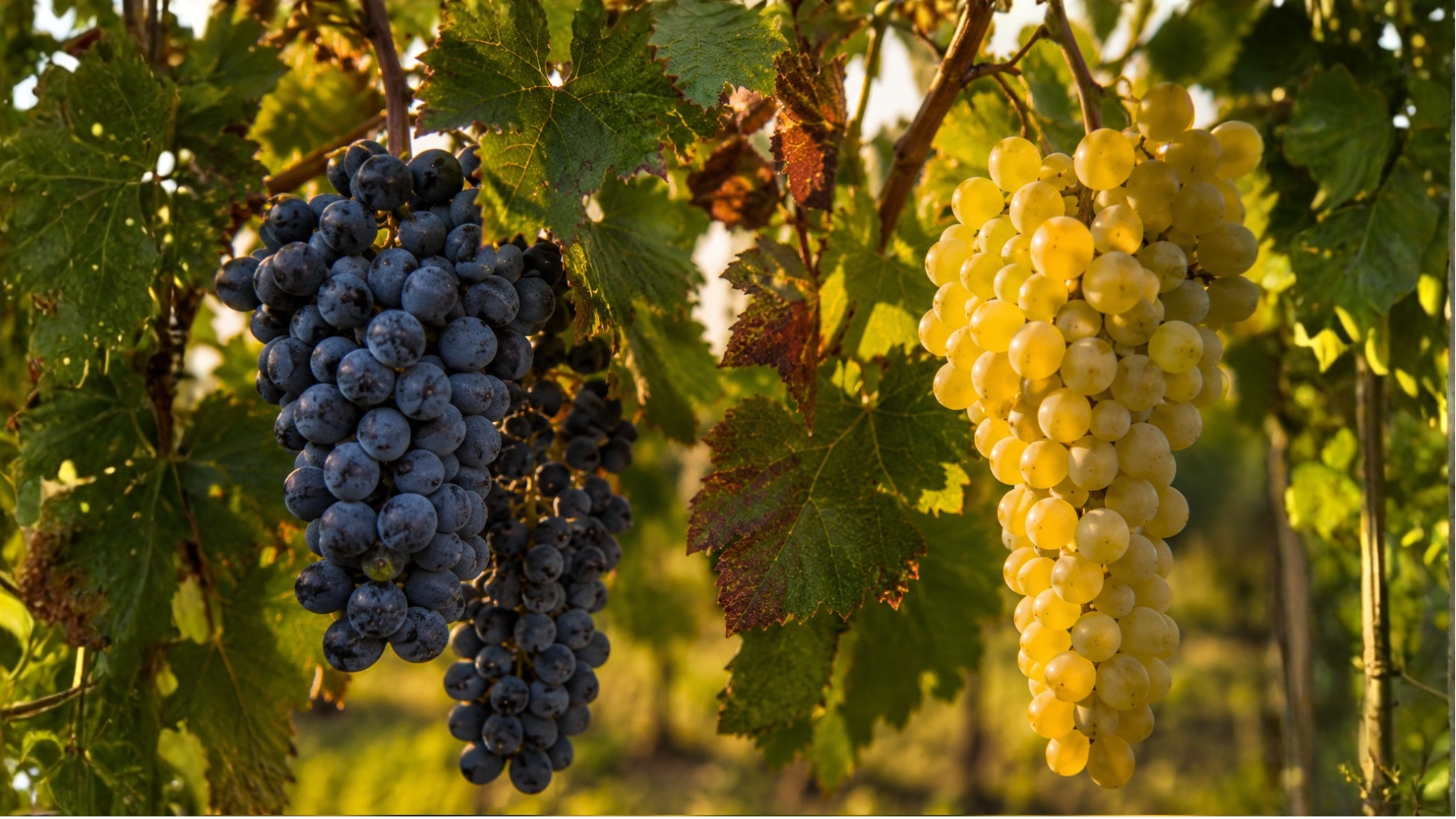
Originally from southwest France, Petit Manseng has small, thick-skinned berries, naturally high acidity, and the ability to carry intensity without collapsing into heaviness. In Virginia, where humidity and disease pressure can make grape growing feel like a knife fight in a greenhouse, thick skins are not a cute detail. They are survival gear.
Virginia Petit Manseng can be dry, off-dry, or sweet. It can smell like pineapple, citrus peel, mango, honey, flowers, and wet stone. The best ones have a strange and beautiful tension: tropical fruit wearing a crisp white shirt.
That tension is exactly what Virginia does well when it is on form. Fruit, yes. But not lazy fruit. Acidity, texture, and energy holding everything together.
For years, Viognier carried much of Virginia’s white wine reputation. That still matters. But Petit Manseng feels like the grape that arrived late, looked around, and quietly realized the room was built for it.
Why Virginia wine is difficult to make, and why that matters
Virginia is not an easy place to grow wine grapes. That is part of why this Paris moment feels earned.
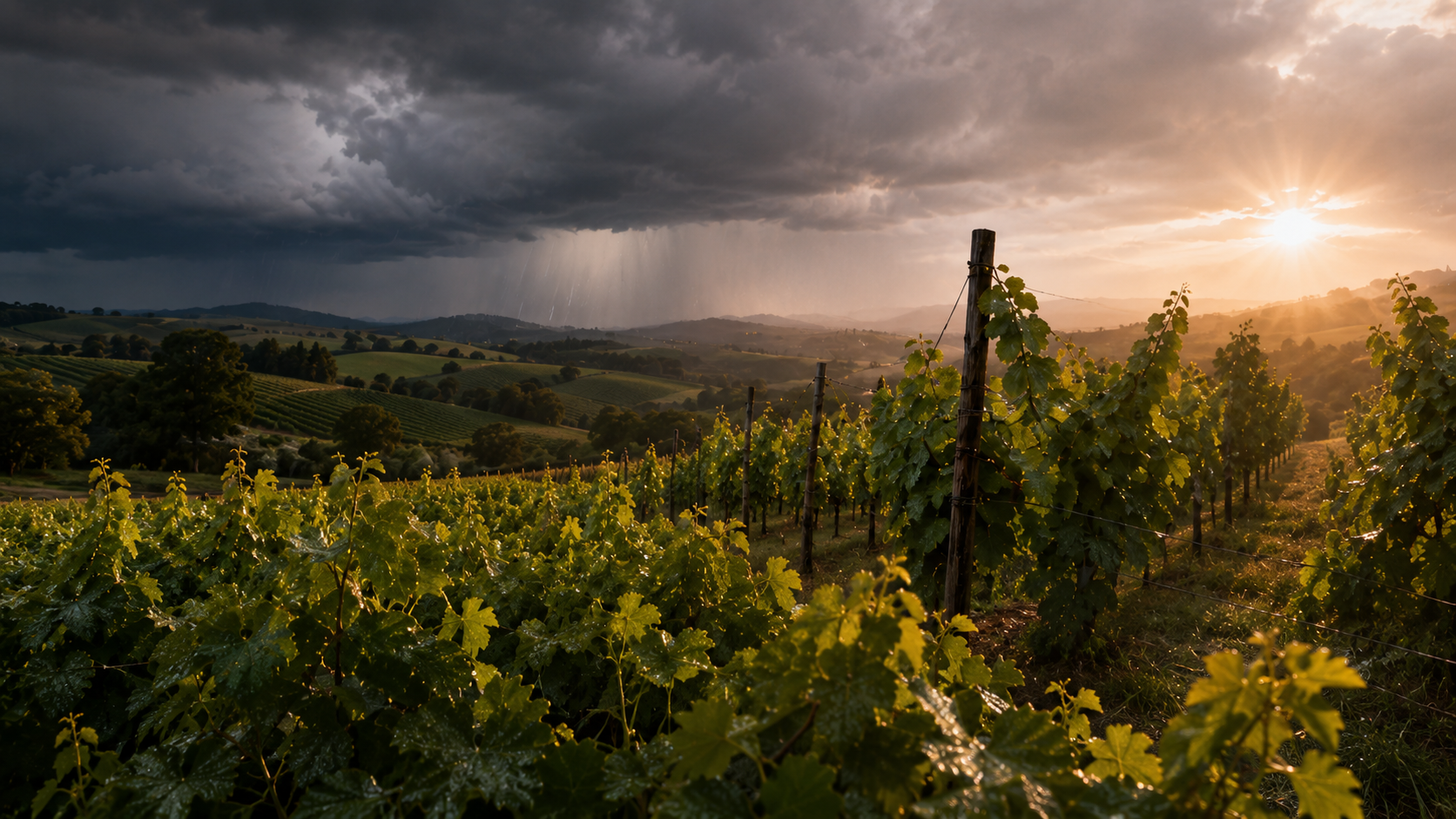
The state deals with humidity, fungal disease pressure, late spring frosts, summer heat, and harvest-season storms. This is not lazy sunshine viticulture. This is farming with one eye on the sky and the other on the disease forecast.
That difficulty can create problems, of course. Thin wines. Green wines. Diluted wines. Wines that taste like the vineyard lost the argument.
But when the right site, right grape, right farming, and right winemaking line up, Virginia can produce wines with a very particular balance: American fruit with a more restrained, food-friendly frame. Not always, but often enough that the pattern is now hard to ignore.
The Oxford Companion to Wine describes Virginia as increasingly known for quality and diversity, especially Bordeaux-style reds based on Cabernet Franc and Petit Verdot, with Petit Manseng becoming a major white wine story. That tracks with what this tasting put under the spotlight.
Virginia is not succeeding because it has perfect conditions. It is succeeding because growers and winemakers have stopped trying to force the wrong dream into the wrong soil.
What should beginners try from Virginia wine?
For beginners, the best Virginia wines to try after this Paris tasting are Cabernet Franc, Petit Manseng, Chardonnay, and Bordeaux-style red blends.
Start with Cabernet Franc if you want red wine that feels savory, fresh, and flexible with food. Look for versions that show red cherry, pepper, herbs, and a clean finish instead of heavy oak or syrupy fruit.
Try Petit Manseng if you want a white wine with personality. Dry versions can be bright and textured. Sweeter versions can be beautiful with spicy food, salty cheese, or a quiet evening where dessert is not really dessert, just an excuse to open another bottle.
Try Virginia Chardonnay if you are tired of the old argument between buttery and boring. The best Virginia examples can bring apple, citrus, cream, and mineral tension without turning into a buttered movie theater floor.
Try red blends if you want the bigger picture. Merlot, Cabernet Franc, Petit Verdot, and Cabernet Sauvignon can work together in Virginia when the blend respects balance over muscle.
Is Virginia wine better than French wine now?
No. That is not the point.
Virginia wine is not “better than French wine” because a few Virginia bottles performed beautifully in one blind tasting. Wine does not work that way. Regions are not boxing teams. A bottle of Cabernet Franc from Afton and a bottle from Bourgueil are not fighting for custody of your palate.
The real point is more useful: Virginia wine can be serious. Virginia wine can compete. Virginia wine can show identity. Virginia wine can make people who thought they already understood American wine pause for a second.
That pause is valuable.
Why this moment should not be wasted
There is a danger after a moment like this. The region can get loud too quickly. The marketing machine can turn one tasting into a crown, then into a slogan, then into something people stop believing because it was pushed too hard.
Virginia should resist that.
The stronger path is quieter and more durable: keep showing the wines, keep telling the growers’ stories, keep explaining the grapes, keep welcoming curious drinkers, and keep improving.
Because the best version of this story is not “Virginia shocked France.”
The best version is: Virginia has been doing the work for decades, and now more people are finally tasting it.
FAQ: Virginia wine and the Paris tasting
Why is Virginia wine getting attention after the Paris tasting?
Virginia wine is getting attention because its wines performed strongly in a blind tasting against French wines at Le Cordon Bleu Paris. The event gave Virginia an unusually symbolic stage and highlighted grapes that are becoming central to the state’s identity.
What Virginia grapes should I try first?
Start with Cabernet Franc, Petit Manseng, Chardonnay, and Bordeaux-style red blends. These styles give a good snapshot of where Virginia wine is strongest right now.
Was this the same as the 1976 Judgment of Paris?
No. The 1976 Judgment of Paris was larger in historical impact and changed the reputation of California wine. The 2026 Virginia tasting is better understood as a symbolic breakthrough, not a final verdict.
Why does Petit Manseng work in Virginia?
Petit Manseng works well in Virginia because its thick skins, high acidity, and strong flavor profile can handle the state’s humid climate better than many delicate white grapes.
Is Virginia wine worth seeking out?
Yes. The best Virginia wines now show real regional identity, especially in Cabernet Franc, Petit Manseng, Petit Verdot, Chardonnay, and red blends. The region is still uneven, but the top producers are no longer curiosities. They are serious.
Final sip
Virginia wine just had its Paris moment. Not the kind where everyone drops their glass and rewrites history overnight. The better kind. The kind that starts with a few people paying closer attention.
That is how wine regions grow up. Not all at once. Not through one trophy. Not through one headline.
They grow through farmers, vintages, failures, better choices, stubborn producers, curious drinkers, and moments like this, when the room gets quiet and the glass says more than the label expected.
Check back on my Wination for more wine stories like this, especially the ones that make the wine world feel a little wider, more human, and more interesting than the old map suggested.
Sources
- Valley Road Vineyards, recap of “Old World, New Roots” at Le Cordon Bleu Paris.
- Paul Vigna, The Wine Classroom, coverage of Valley Road and the Cabernet Franc flight results.
- Office of the Governor of Virginia, 2026 Virginia Governor’s Cup announcement.
- Virginia Wine, Virginia Governor’s Cup competition details and judging format.
- Virginia Wine, overview of Virginia wine regions, acreage, AVAs, and regional story.
- Smithsonian National Museum of American History, 50th anniversary of the Judgment of Paris.
- The Oxford Companion to Wine, 5th edition, edited by Julia Harding MW, Jancis Robinson OBE MW, and Tara Q. Thomas. Purchase link: Oxford University Press.
- The Wine Bible, 3rd edition, Karen MacNeil. Purchase link: Workman Publishing.
- Richard Leahy, Beyond Jefferson’s Vines: The Evolution of Quality Wine in Virginia. Purchase link: Richard Leahy author page.

Comments